If you want to know about crochet abbreviations explained, this guide covers everything you need. You found a gorgeous pattern online, downloaded it excitedly, and then opened it to find something that reads like encrypted military communication: “Ch 3, dc in next 4 sts, 2 dc in next st, *dc in next 5 sts, 2 dc in next st*, rep * to * across. (35 dc).” If you’ve ever felt personally attacked by a crochet pattern, you’re not alone. Crochet abbreviations are a compact language that takes a little study to decode, but once you learn it, you’ll read patterns as naturally as you read a recipe.
This guide covers every common crochet abbreviation, explains the important difference between US and UK terms, and teaches you to read patterns with confidence.
Basic Crochet Abbreviations (US Terms): Crochet Abbreviations Explained
The United States crochet abbreviation system is used in the majority of English-language patterns published in North America, and it’s what most online patterns default to. Here are the fundamental abbreviations you’ll encounter in almost every pattern.
| Abbreviation | Meaning | Description |
|---|---|---|
| ch | Chain | The basic loop stitch that forms the foundation |
| sl st | Slip stitch | Flat stitch used for joining or moving position |
| sc | Single crochet | Shortest basic stitch, creates dense fabric |
| hdc | Half double crochet | Medium-height stitch, nice drape |
| dc | Double crochet | Tall stitch, most common in many patterns |
| tr (or tc) | Treble crochet | Very tall stitch, creates open fabric |
| dtr | Double treble crochet | Extra tall stitch, uncommon in beginner patterns |
| st(s) | Stitch(es) | Refers to any completed stitch or stitches |
| sp(s) | Space(s) | The gap between stitches or clusters |
| yo | Yarn over | Wrapping yarn around the hook |
| sk | Skip | Miss the next stitch |
| rep | Repeat | Do the instruction again |
| prev | Previous | The one before the current position |
| rem | Remaining | The stitches left to work |
| tog | Together | Work stitches together (decrease) |
| inc | Increase | Add a stitch (usually 2 stitches in 1) |
| dec | Decrease | Remove a stitch by combining two |
| beg | Beginning | The start of a row or round |
| RS | Right side | The front/public side of your work |
| WS | Wrong side | The back/private side of your work |
Structural and Technique Abbreviations
Beyond basic stitches, patterns use abbreviations for techniques, positions, and structural elements.
| Abbreviation | Meaning | Description |
|---|---|---|
| FO | Fasten off | Cut yarn and pull through last loop to finish |
| BLO | Back loop only | Insert hook in back loop instead of both loops |
| FLO | Front loop only | Insert hook in front loop instead of both loops |
| FPdc | Front post double crochet | Work around the post from the front (creates texture) |
| BPdc | Back post double crochet | Work around the post from the back |
| FPsc | Front post single crochet | Single crochet around the post from the front |
| MC | Main color | The primary yarn color |
| CC | Contrasting color | A secondary yarn color |
| CC1, CC2 | Contrasting color 1, 2 | When multiple contrast colors are used |
| MR | Magic ring | Adjustable starting loop for working in the round |
| rnd(s) | Round(s) | When working in the round (vs. rows) |
| tch | Turning chain | The chain made when turning at end of a row |
| pm | Place marker | Put a stitch marker at this point |
| sm | Slip marker | Move the marker to the current stitch |
| lp(s) | Loop(s) | The loops of yarn on your hook |
| ea | Each | In every stitch mentioned |
| alt | Alternate | Every other one |
The US vs. UK Terminology Trap
This is where things get confusing, and if you’ve ever followed a pattern and gotten completely wrong results, this might be why. The US and UK use the same abbreviations for different stitches. A “double crochet” in a US pattern is a completely different stitch from a “double crochet” in a UK pattern.
| US Term | UK Equivalent |
|---|---|
| Slip stitch (sl st) | Slip stitch (sl st) |
| Single crochet (sc) | Double crochet (dc) |
| Half double crochet (hdc) | Half treble crochet (htc) |
| Double crochet (dc) | Treble crochet (tr) |
| Treble crochet (tr) | Double treble crochet (dtr) |
| Double treble (dtr) | Triple treble (ttr) |
The critical thing to notice is that the UK system is shifted up by one. A US single crochet = UK double crochet. A US double crochet = UK treble. This means that if you follow a UK pattern using US terms (or vice versa), every stitch will be the wrong height, and your project will be the wrong size and shape.
How to tell which system a pattern uses: Most published patterns state “written in US terms” or “written in UK terms” at the beginning. If there’s no indication, look for the term “single crochet.” If the pattern uses “sc” or “single crochet,” it’s US terminology. UK patterns don’t have a stitch called single crochet; their shortest stitch after the slip stitch is the double crochet. According to the Craft Yarn Council, the US system is the standard for patterns published in North America.
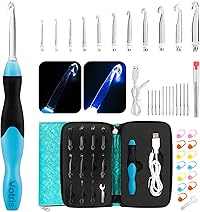
- 【Adjustable Brightness & Comfortable Hold】Enjoy the perfect combination of adjus
- 【Versatile Crochet Kit】Our light up crochet hook kit includes 11 interchangeable
- 【Beginner-Friendly Crochet Kit】Our light up crochet hook kit is specifically des
Pattern Symbols and Formatting
Beyond abbreviations, crochet patterns use specific punctuation and formatting conventions. Understanding these is just as important as knowing the stitch abbreviations. Mastering crochet abbreviations explained takes practice but delivers great results.
Asterisks (* *)
Asterisks indicate a section that repeats. Everything between * and * (or sometimes * and “repeat from *”) should be worked multiple times as instructed.
Example: *Sc in next 3 sts, 2 sc in next st*, repeat * to * across.
This means: single crochet in 3, increase in the next. Do that pattern all the way across the row.
Brackets [ ] and Parentheses ( )
These are used in two ways:
- Grouping stitches worked in the same place: (2 dc, ch 2, 2 dc) in corner sp. All of those stitches go into one space.
- Repeat count: [sc in next 5 sts, inc] x 6. Work the bracketed section 6 times.
- Stitch count: (24 sc) at the end of a row tells you the total number of stitches you should have.
Stitch Count in Parentheses
The number in parentheses at the end of a row or round is your lifeline. It tells you exactly how many stitches you should have at that point. If your count doesn’t match, something went wrong in that row. Count your stitches frequently, especially as a beginner. This single habit prevents more mistakes than any other.
Multiple Sizes
Garment patterns often include instructions for multiple sizes, separated by parentheses or brackets: “Ch 50 (54, 58, 62).” The first number is the smallest size, and each subsequent number in parentheses is a larger size. The pattern will tell you which size corresponds to which measurement at the beginning.
Stitch Combination Abbreviations
Some patterns use abbreviations for specific stitch combinations that appear frequently in that pattern. Understanding crochet abbreviations explained is key to a great craft hobby.
| Abbreviation | Meaning | How It’s Made |
|---|---|---|
| sc2tog | Single crochet 2 together | Start sc in one stitch, start sc in next, finish both at once (decrease) |
| dc2tog | Double crochet 2 together | Start dc in one stitch, start dc in next, finish both at once |
| dc3tog | Double crochet 3 together | Same concept with 3 stitches combined |
| V-st | V-stitch | Usually (dc, ch 1, dc) in same stitch |
| shell | Shell stitch | Multiple dc in the same stitch (usually 5 dc) |
| cl | Cluster | Group of stitches worked together at the top |
| pc | Popcorn stitch | Multiple dc in one stitch, joined at top |
| puff | Puff stitch | Multiple half-finished dc pulled through at once |
| bob | Bobble | Similar to popcorn, creates a bump |
Note that shell, cluster, popcorn, puff, and bobble can vary between patterns. A “shell” in one pattern might be 5 dc, while another defines it as 3 dc-ch1-3 dc. Always check the pattern’s stitch glossary if one is provided.
How to Read a Full Pattern
Let’s walk through decoding an actual pattern section step by step.
Pattern excerpt:
Row 5: Ch 1, sc in first st, *sk next st, 5 dc in next st (shell made), sk next st, sc in next st*, rep * to * across, turn. (5 shells)
Translation:
- Chain 1 (your turning chain).
- Single crochet in the first stitch.
- Skip the next stitch.
- Put 5 double crochets into the next stitch (this creates a fan/shell shape).
- Skip the next stitch.
- Single crochet in the next stitch.
- Repeat steps 3 through 6 all the way across the row.
- Turn your work.
- When you’re done, you should count 5 shell groups.
The key insight is that patterns are sequential instructions. Read left to right, do each thing in order, and the stitch count at the end confirms you did it correctly.

- Crochet hooks for arthritic hands has black natural wood handle, lightweight, no
- Crochet Kit for Beginners have an independent slot for easy access. It has clear
- Crochet set has metal inline hook heads, repeatedly polished, smooth and durable
Crochet Chart Symbols
Some patterns include visual charts alongside (or instead of) written instructions. Charts use standardized symbols to represent stitches, giving you a visual map of your project. When it comes to crochet abbreviations explained, preparation matters most.
| Symbol | Stitch |
|---|---|
| o or small oval | Chain (ch) |
| dot or filled circle | Slip stitch (sl st) |
| x or + (plus sign) | Single crochet (sc) |
| T shape | Half double crochet (hdc) |
| T with one crossbar | Double crochet (dc) |
| T with two crossbars | Treble crochet (tr) |
Charts are read from bottom to top. For flat work (rows), odd rows read right to left, and even rows read left to right. For round work, all rounds read counterclockwise. Many crocheters find charts easier to follow than written instructions because you can see the shape of the fabric forming.
Tips for Pattern Reading Success
- Read the entire pattern first. Don’t start crocheting at the first line. Read through everything so you understand the structure and anticipate what’s coming.
- Check for a stitch glossary. Many patterns define their special stitches at the top. Read this section carefully.
- Verify US or UK terms. Before making a single stitch, confirm which terminology the pattern uses.
- Count after every row. Use the stitch count at the end of each row to verify your work. Catching a mistake immediately is much easier than discovering it 10 rows later.
- Highlight as you go. Print the pattern and use a highlighter to mark completed rows. Or use a row counter app on your phone.
- Look up unfamiliar abbreviations. If you encounter an abbreviation not on this list, the pattern may define it, or a quick search will explain it.
Frequently Asked Questions
What does “ch 3 (counts as dc)” mean?
This means your chain of 3 at the beginning of a row is acting as your first double crochet stitch. Instead of making a chain 3 and then doing a dc in the first stitch, the chain itself is the first dc. This means you skip the first stitch and work your next dc in the second stitch. At the end of the row, you’ll work your last stitch into the top of this ch-3.
What is the difference between “sc in next st” and “sc in each st across”?
“Sc in next st” tells you to single crochet in one specific stitch. “Sc in each st across” tells you to single crochet in every remaining stitch until you reach the end of the row. The first is a precise instruction for one stitch, and the second is a shorthand for repeating the same action across the entire row.
How do I know if a pattern uses US or UK crochet terms?
Most patterns state the terminology at the beginning. If there’s no indication, look for “single crochet” or “sc” in the pattern. US patterns use single crochet as their shortest basic stitch. UK patterns don’t have a stitch called “single crochet.” If the pattern mentions “treble” as a basic stitch (not treble crochet), it’s likely UK terminology. When in doubt, check the designer’s country of origin.
What does “work even” mean in a crochet pattern?
“Work even” means to continue crocheting without increasing or decreasing. Simply repeat the same stitch pattern for the specified number of rows or rounds, keeping the stitch count constant. This instruction usually appears after a section of shaping (increases or decreases) and before the next shaping section.
What does “fasten off” mean?
“Fasten off” means to permanently secure your last stitch so your work doesn’t unravel. Cut the yarn leaving a 6-inch tail, then pull the tail completely through the loop on your hook. The tail is then woven into the finished fabric using a yarn needle to hide it and prevent loosening.
Frequently Asked Questions
What does ‘ch’ mean in a crochet pattern?
‘Ch’ stands for ‘chain,’ which is the basic loop stitch that forms the foundation of your crochet project. Every crochet pattern starts with a chain stitch, so mastering this abbreviation is your first step to understanding any pattern you encounter.
Why do I need to know crochet abbreviations explained if I’m just starting out?
Learning crochet abbreviations is essential because they allow you to read patterns quickly and accurately, just like following a recipe. Once you understand the common abbreviations like ‘sc,’ ‘dc,’ and ‘rep,’ you’ll be able to tackle patterns that initially look like encrypted military communication.
What’s the difference between US and UK crochet abbreviations?
The US and UK use different terms for the same stitches, which can be confusing when following patterns from different regions. The article covers these important differences so you know which abbreviation system your pattern is using before you start stitching.
What does ‘rep’ mean and how do I use it in a crochet pattern?
‘Rep’ is short for ‘repeat,’ which tells you to do an instruction again, often indicated by asterisks like ‘rep * to * across.’ This abbreviation helps patterns stay compact while instructing you to work the same sequence multiple times across a row or round.